Ινστιτούτο Νίκος Πουλαντζάς
Birkbeck Institute of the Humanities
Θεωρία στο Μέγαρο
ΕΦΣΥΝ ‘Πολιτικά & Φιλοσοφικά Επίκαιρα’
Open Athens

Brazil’s existential elections (1)


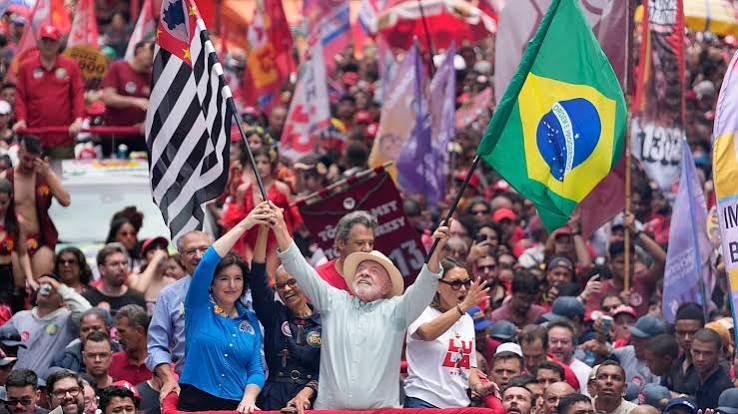
Next Sunday’s presidential election between Lula da Silva and Flávio Bolsonaro, son of the imprisoned Jair, concerns Brazilians, but its results will affect the rest of the continent and the whole world. Brazil is the largest and most densely populated country in Latin America, one of the world’s ten largest economies, and a founding member of the BRICS. But over the last 18 months, the right and the far right, with open support from Trump, have won in seven countries. “We’re doing very well in South America,” Trump said last month. “I’ve elected a lot of presidents.” But the big prize is Brazil. In the first round, Bolsonaro defied the odds by securing two million more votes than Lula and is now the favourite.
My friend Juliana, a lecturer at the Federal University of Rio de Janeiro, wrote to me the day before yesterday. ‘We’re all feeling very anxious, as there are just a few days left until the election. Once again, Brazil is facing the prospect of a far-right government, and many of us are deeply concerned about what this might mean for our country. It is hard to understand how so many people seem indifferent to the serious allegations and controversies surrounding the Bolsonaro family’s candidate. Sometimes I feel that political polarisation has created a sort of wall that makes it difficult for people to listen, to question, to see things differently. We are working very hard on the election campaign and sincerely hope that Lula will be re-elected on the 25th of this month. He represents much more than just a political candidate.
He is a leader of great importance to Brazil and, I believe, to the world, particularly at a time when democracy is under such immense pressure in various parts of the globe. For many of us — academics, women, indigenous peoples, members of the LGBTQI+ community and so many others — the stakes feel deeply personal. At times, they feel almost existential.”
Forty years ago, the Brazilian people overthrew one of the bloodiest military dictatorships in South America. The transition to democracy coincided with neoliberalism’s assault on social justice and democracy. However, social movements and dynamic trade unions succeeded in consolidating democracy. The progressive Constitution of 1988 introduced institutions of direct democracy, including participatory budgeting and people’s assemblies. In 2001, Brazil hosted the first World Social Forum, and in 2002, the tenacious Lula was elected president on his fourth attempt. Lula, a metalworker and trade unionist, became known as a strike leader during the dictatorship. The limited welfare state was established during his presidency, and the famous welfare programmes (bolsa familia) lifted forty million people out of extreme poverty. During Lula’s years in office, GDP grew by an average of 4.5 per cent.
Barack Obama described Lula as ‘the most popular politician in the world’. But the Brazilian establishment did not take to him. A few months before the 2018 elections, with Lula leading Bolsonaro by 15 per cent, the judge and Lula’s fanatical persecutor, Sergio Moro, convicted him of money laundering. Stripped of his political rights, Lula was unable to stand as a candidate and Bolsonaro was elected. His first act was to appoint Moro as Minister of Justice.
In 2021, after 580 days in prison, the Supreme Court quashed the conviction as entirely unfounded, and found that the judges had acted with bias against Lula in collusion with the prosecutors. Despite constant assurances regarding the rule of law, the judiciary everywhere sides with the interests of capitalism when its dominance is threatened.
Lula-Molsonao the Elder
During the previous presidential elections in September 2022, I was in Rio de Janeiro to give lectures at the Federal University and at PUC-Rio, where I have been a visiting professor for the past ten years. The atmosphere in Copacabana and Ipanema, the city’s iconic beaches, was electric. At the huge carnival parade organised by the Workers’ Party on the Sunday before the first round of the presidential elections, the only question was whether Lula would be elected president on the first Sunday or whether there would be a run-off. There was great fear of what might happen otherwise. Bolsonaro, a former high-ranking military officer, threatened to follow Trump’s example and contest the result, and hinted that a military coup might be staged by his supporters in the armed forces if he lost.
The Workers’ Party’s main event in Rio was a carnival-style parade in a central park. Colourful floats, costumes and bands, songs and flags. The ‘Lulistas’, with dozens of stickers on their clothes, carried flags bearing Lula’s image and those of the left-wing coalition’s candidates for state governors, state and federal MPs. The number 13 dominated. Voting is electronic, and the results are announced one hour after the polls close. Candidates are assigned a number on the screen; 13 is Lula’s lucky number in the six elections in which he has stood as a candidate.
The procession moved along like a snake. Each float presented a story or an image of what Lula had achieved during his two terms as president. At our own major party rallies, supporters are mere extras; their role is passive. They applaud the leader, shout slogans; the turnout must be larger than the opponent’s. In Brazil, there were no speeches or cheers. The participants staged the ‘performance’. They sang, put on short skits, improvised and expressed their hopes and expectations. The only common slogan was ‘Fora Bolsonaro – Bolsonaro out’. Such practices led to the ‘collective candidacies’ that appeared for the first time in the elections. Many candidates stood together for a single seat and promised to share knowledge, skills and responsibilities. The joint candidacies came from left-wing collectives. Ten young people stood as ‘Lula Youth’, whilst five Afro-Brazilian feminists ran under the slogan ‘Cast one vote, get five black women’. ‘We’re hacking the political system,’ an LGBTQI activist told me. ‘One will be elected, but the mandate will be collective’.
The election campaigns of both Bolsonaros were toxic. The father utilised the security services and appointed 6,000 members of the armed forces to government posts. The Federal Highway Police did everything in its power to hinder the movement of Lula’s supporters on election day. Amid the climate of violence it fostered, the journalist Dom Phillips, Bruno Pereira – an indigenous Amazonian expert – and four of Lula’s supporters were murdered. The Amazon, ‘the lungs of the Earth’, is vital for the global climate and biodiversity. But for the Bolsonaros, those who support the rainforest are enemies. The fires and deforestation permitted by Bolsonaro, so that his cronies could use the scorched land for livestock farming, soya cultivation and tourism, have pushed the Amazon to the brink. Bolsonaro, father and son, represent the three Bs: Bible, beef and bullets.
In 2022, Lula won the second round with 50.90 per cent of the vote. A major victory for a politician who, just a year earlier, had been in prison and was considered politically finished. Bolsonaro kept his word and refused to accept the election result, just like Trump. In 2025, he was sentenced to 27 years’ imprisonment for attempting to organise a coup. The conspiracy culminated in the far-right uprising on 8 January 2023 in Brasília, which mimicked the storming of the US Capitol on 6 January 2021.
Despite the major successes of Lula and the Workers’ Party, and the toxic policies of the Bolsonaros, how is it that the youngest Bolsonaro is the favourite to win next Sunday? Some answers in the next instalment.
Costas Douzinas’s new book “Law’ Desire” (Nisos 2026) will be published on 21 October.