Ινστιτούτο Νίκος Πουλαντζάς
Birkbeck Institute of the Humanities
Θεωρία στο Μέγαρο
ΕΦΣΥΝ ‘Πολιτικά & Φιλοσοφικά Επίκαιρα’
Open Athens

The endless war


The Endless War
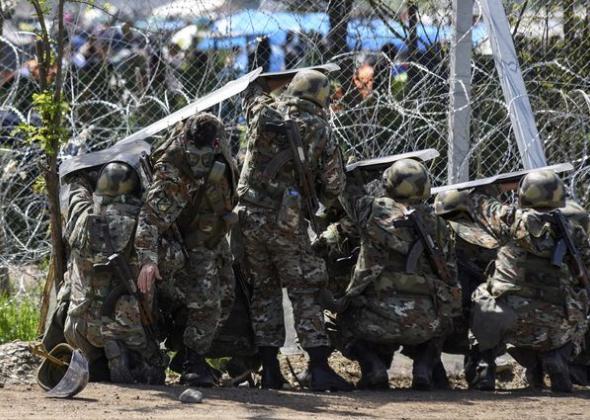
At the beginning of the 21st century, proponents of cosmopolitanism and the “end of history” promised “eternal” peace and the “dividends” of peace. Instead, we have eternal war and an arms race. We have entered an era of endless global war—both domestically and internationally. In my book States of Exception (Elgar 2024), I argued that over the past 30 years we have experienced major states of emergency: the economic crisis, the pandemic, the influx of refugees and migrants, and the ever-present “war on terror.” Governments have adopted extreme policies to keep migrants out, often killing them; they took unprecedented measures to suspend basic political and socioeconomic rights during the pandemic; and they implemented extreme austerity measures that impoverished the population. Social security has been replaced by national security, which allows the state to violate legal boundaries. The economy and society are gradually being militarized. Military spending is shaping economic growth—as called for in the EU report “Rearm Europe” and the increase in defense spending to 5% of GDP. Since 2010, we have witnessed an arms race. In 2024, global military spending reached $2.7 trillion, accounting for 7% of public spending. It increased by 37% from 2015 to 2024.
The militarization of society takes many forms: an increase in police and repressive forces; the criminalization of political protest and excessive penalties; Open and covert surveillance, data collection from social media, targeting of potential dissidents and movements, and the general enforcement of obedience to various forms of authority. Open and covert surveillance of politicians and citizens, espionage, data collection from social media, and the targeting of dissidents and movements—with environmental groups and solidarity campaigns for Palestine at the forefront. But there is also a broader effort to reinforce obedience to authority, entrench racial and gender hierarchies, attack and exclude immigrants, and undermine the rights of gay people, lesbians, and transgender people. All of this is directed against an enemy that neither wants nor is capable of seizing power. Never since the early 20th century has the prospect of a revolution been so remote and the legal counterrevolution so violent.
Let’s turn to international relations. On September 25, 1997, two Mossad agents poisoned Hamas leader Khaled Meshaal in Amman, Jordan. Within a few hours, Meshal was on the verge of death. The agents were arrested and were to be tried and executed. President Bill Clinton demanded that Netanyahu, during his first term as prime minister, provide the antidote. He complied, and even traveled to Amman to personally apologize to King Hussein. Meshal survived. Instead of killing him, Netanyahu brought the Hamas leader back to life.
Today, high-ranking politicians, including the top leaders of countries such as Venezuela and Iran, are systematically assassinated or abducted by the U.S. and Israel. What has happened between 1997 and today?
Recent headlines from newspapers and academic journals may provide the answer: I quote: “Are we witnessing the death of international law?” “Did Trump kill international law—or was it already dead?” “The great disintegration has begun.” We are experiencing the gradual collapse of international law. But is that really the case?
Postwar international law was accompanied by the principle of hierarchy and state privileges. This principle was introduced at the Congress of Vienna with the special privileges granted to the five “Great Powers,” and was reiterated in the League of Nations and among the five permanent members of the UN Security Council.
The famous liberal rules-based order—whose decline many lament—allowed the powerful to exempt themselves from its application. Canadian Prime Minister Michael Carney shocked the world by revealing this well-known “secret,” like the child who cried out that the emperor had no clothes.
International rules are created and sustained through the consensus of states; compliance depends on their goodwill. It can be revoked. Compliance combines the factual with the legal: the sovereign complies, and this fact creates or maintains the rule to which it complies. Whether a rule exists and for whom, or whether it has declined and collapsed, is an empirical phenomenon with normative implications. Trump has reinforced this fragile nature of the law. As Marco Rubio stated: “The postwar world order is being used against us… a foreign policy that serves core national interests cannot be replaced by the ‘liberal world order.’” Trump boasted that the only limit to his global power was “my own morality. My own mind… I don’t need international law.” The U.S. has withdrawn from 60 international organizations and agreements—including the Paris Climate Agreement, the World Health Organization, and the UN Human Rights Council—and have imposed sanctions on judges and lawyers working at the International Criminal Court. Pete Hegesez famously declared that his Pentagon would not “follow any stupid legal rule” to limit its wars.
The law still exists, but it does not apply to the United States; withdrawal has suspended the voluntary agreement. Illegal war is part of international law in the same way that extraordinary violence is part of the domestic rule of law.
The great left-wing intellectual Perry Anderson put it plainly: “International is neither international nor law.” I agree only in part. It is not “international” only for the superpowers and their satellites, which can exempt themselves from the so-called “liberal rules-based order.” It is not “law” only for certain parts of international law, particularly the law of war, the rules aimed at minimizing its devastating effects, such as the law on genocide, the Geneva Conventions, principles such as proportionality and distinction, as well as humanitarian law. What happened in Gaza, Lebanon, Venezuela, and Gaza is not merely a matter of violations, but a complete abandonment of and withdrawal from international humanitarian law. But Iraq, Afghanistan, Ukraine, and Iran show that despite initial quick victories, overwhelming military superiority ultimately fails.
But international law is indispensable when it comes to economic and trade relations. Rules governing international trade and the seas, corporate law, intellectual property, banking law, and foreign investment distribute rights and obligations, powers and vulnerabilities. The law that constitutes the unjust legal framework of global capitalism is powerful and effective. The World Bank’s structural adjustment programs and the EU and IMF’s memoranda, for example, are legal impositions that devastate populations without military invasion or bombings.
We thus have a convergence of domestic repression and endless war. Trump views foreign relations in terms of policing and domestic policy in terms of war—two sides of the same coin: ICE and F-16s, Minneapolis and Gaza.
A global police operation links domestic and international violence but often fails. How can we explain this? What purpose do the failures of the overwhelming war machine serve? I believe it is a governance plan. I call it the “war regime.” We live through a period of transition from one form of capitalist accumulation and political legitimization to another. Transitions create turmoil. The predictable horizon of societies has collapsed—uncertainty is the only certainty, accompanied by disappointment and anxiety. Thus, the state of war grants governments repressive powers and terrorizes the population with the ever-present fear of an impending war. Under these conditions, only radical visions for society can successfully compete. Social classes are ready to support one of them. The far right offers such a plan and has the upper hand, especially in Europe. The left does not seem to have an answer at the moment. To paraphrase Benjamin, let us say that the rise of the far right is the result of the left’s failure.
But let’s end on an optimistic note. The 21st century has been the century of resistance. From the Arab Spring and the occupations of the 2010s, to resistance against lockdowns, climate activists, and solidarity with Palestine, we know that resistance inherently challenges the dominant powers and reshapes the balance of power. We do not know when the next major upheaval will take place, but we know it will happen. And the “state of war” may suggest that the dominant forces are aware of this and are buying insurance for the future.
Costas Douzinas’s new book, *The Desire of the Law*, will be released on October 15 by Nisos Publishing.